Orchestration
How three agents ship our backlog with nobody at the keyboard
Manager, executors and reviewer: how we split delivery work between agents, what each role is forbidden to do, and why only one of them writes the board.
Our delivery loop runs three agents with closed roles: a manager that writes the board and merges, parallel executors that write the code, and a reviewer that appears only when a merge conflicts. None of them does another's job, and a hook blocks any subagent that tries to do the manager's.
This post shows the split, why each role exists and what each one is forbidden to do. All of it comes from the code of our in-house loop (arcvs-loop), not from a slide.
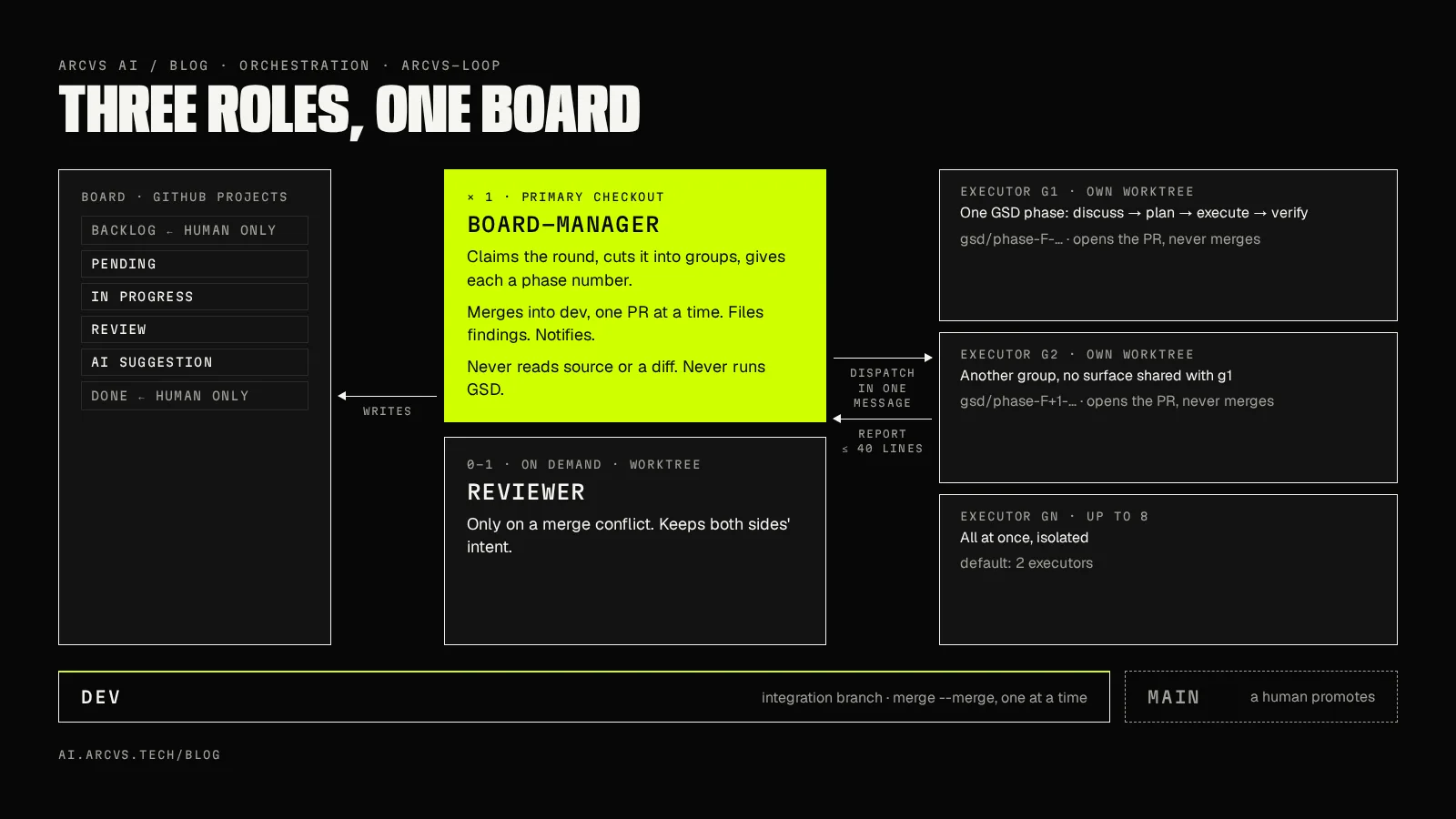
Three roles, three lifetimes
| Role | How many | Runs in | Lives for |
|---|---|---|---|
| board-manager | 1, the session itself | primary checkout | the whole run |
| executor | up to --executors (default 2, max 8) |
its own worktree | one group of issues |
| reviewer | 0 or 1, on demand | its own worktree | one conflict |
The manager takes a round of issues from the board, cuts it into groups and dispatches one executor per group, all in a single message so they run at the same time. Each executor takes its group from nothing to a pull request against dev. The manager merges, moves the board and sends the notification.
Each executor runs as a subagent with isolation: worktree. The Claude Code subagents docs say every subagent gets its own context window, and worktree mode gives it an isolated copy of the repository. A git worktree is exactly that: several working trees attached to the same repository. Two executors never edit the same directory.
The manager does not read code
With three roles in one process, the manager's context is the scarce resource: it is the only one that has to last the whole run. So it never reads source, never reads a diff and never watches a test run.
What it holds is the round: which issues, which groups, which branches, which PRs. Each executor hands back at most 40 lines and writes the long version to a report that is posted on the PR.
To know whether a branch is clean without reading the diff, the manager runs arcvs-diff-check, which scans only the added lines:
arcvs-diff-check <repo_dir> dev <branch>
#   exit 0  clean
#   exit 1  soft: comments, TODOs          -> one cleanup round-trip with the executor
#   exit 2  hard: commented-out code, console.log, .only, conflict markers -> no merge
The skill states the reason plainly: an executor grading its own work is the weakest link in the round. The check costs a dozen lines of context instead of a thousand.
The executor is the only role that runs GSD
GSD is the phase workflow our executors follow: discuss, plan, execute, verify. Only the executor runs it, and each one gets a distinct phase number from the manager, so two executors never write into the same planning folder.
The executor's forbidden list (agents/arcvs-executor.md) is short and strict:
- no board writes, no notifications
- opens the PR, never merges it
- no
gh issue create|edit|comment|close: findings go in the report - no push or merge into
devormain - asks the human nothing; a doubt it cannot settle becomes a
BLOCKEDreport
Bugs outside the scope are not fixed there. They become up to five findings in the report, each with a symptom, a file:line and who feels it.
The reviewer exists only for conflicts
Executors run in parallel and the manager merges one PR at a time into dev. The second PR meets a dev that has already moved. It usually merges clean; when it does not, the manager calls the reviewer.
Its job is to keep both intents alive. It reproduces the conflict, classifies every path, and only then edits:
- planning files: keep both phases in
ROADMAP.md - lockfiles and snapshots: regenerate, never hand-merge
- code: write the version that achieves both goals
Taking one whole side with --ours or --theirs as a default is forbidden, because it throws away the other side's intent. If both cannot be kept, the verdict is UNRESOLVED and the group is blocked.
One board writer, enforced by a hook
The split holds because it is mechanical. The hook hooks/arcvs-role-gate.sh runs before each shell command and blocks, from a worktree, board writes, arcvs-notify, gh pr merge and issue writes. Every subagent lives in a worktree, so only the manager gets through. The Claude Code hooks reference documents that a PreToolUse hook can block the tool call.
The board columns have clear owners:
| Column | Means | Who writes it |
|---|---|---|
| Backlog | authorized work | human only |
| Review | merged into dev, waiting for a read |
manager |
| AI Suggestion | findings not yet authorized | manager and human |
| Done | read and promoted | human only |
The CLI refuses to move an agent-filed issue into Backlog. No agent authorizes its own finding.
dev belongs to the agents, main belongs to you
Every group branches from dev and every PR targets dev. The manager merges without asking, with --merge and never squash, so the history shows which group delivered what.
One side effect: Closes #42 does not close the issue on that merge. GitHub only reads those keywords when the PR targets the default branch. The issues close as a batch when a person promotes dev to main, which is what we want.
What it costs and what does not work
- A group is one review unit and one revert unit. Three issues in one PR share a branch; if one fails verification, all three wait.
- Warning the executors does not prevent a conflict. They run isolated and cannot reach each other. When two groups name the same entity, the only fix is moving one to the next round.
- Parallelism has a ceiling. The default is two executors; more needs a machine that can install dependencies and run test suites side by side.
Where to start
If you run a single agent today, first separate who writes the board from who writes code, and make that a rule a hook checks, not a line in a prompt. The rest of the split can come later.
FAQ
Why not use one agent for everything?
A single agent's context fills with source, diffs and test output, and it ends up managing the board from a degraded memory. Splitting coordination from coding keeps the coordinator small and the board with one writer.
Don't parallel agents cause merge conflicts?
They do when two groups touch the same surface. So only groups with no shared module or entity run together, merges land in dev one at a time, and a reviewer is called only when a merge conflicts.
Can an agent approve its own work?
No. What it delivers goes to Review and waits for a human read; what it finds is born in AI Suggestion. Only a person moves anything to Backlog or Done.